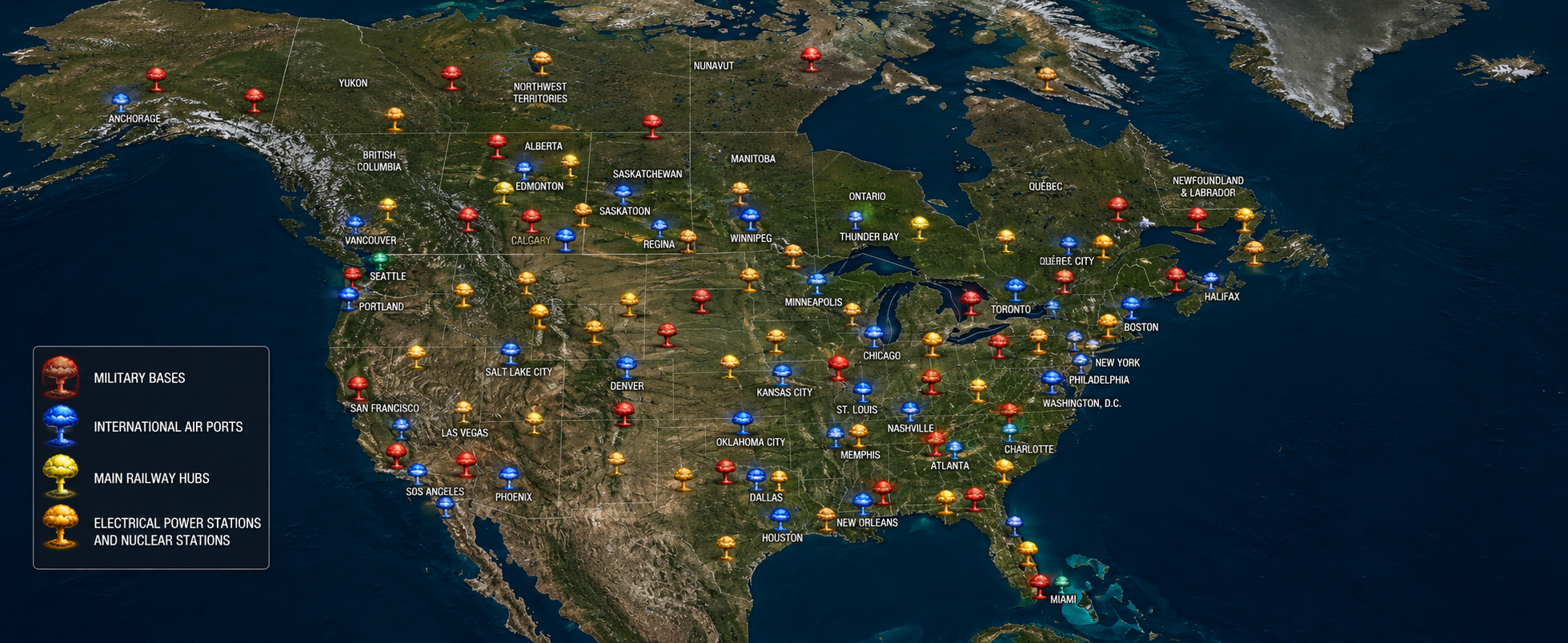
Look at a map of North America and you'll see a target rich environment. Every red mushroom is a military base, blue marks major airports, yellow indicates key rail hubs, and gold shows power plants and nuclear facilities. These are the first targets in a major conflict. One misstep and critical infrastructure across the continent could be annihilated within hours.
This is why Iran can't be trusted with nuclear technology. Their program was never about civilian use - it's a direct path to building warheads. A regime that chants "Death to America" and funds terrorism can't be given the benefit of the doubt. They'll create WMDs and use them.
Unstable countries like North Korea already have WMDs. They're somewhat restrained by China's influence, but relying on Beijing to control Pyongyang is a thin line of defense. One miscalculation or bold move by Kim could spark catastrophe.
Nuclear deterrence worked during the Cold War because it was a bipolar world - both sides feared mutual destruction. Today, the world is multipolar, with more rogue actors and weaker red lines. Leaders may not prioritize survival like they used to. Proliferation increases the odds of eventual use dramatically.
The map doesn't lie - modern civilization is fragile. Dense concentrations of military, transport, energy, and population centers mean any nuclear exchange would be catastrophic. This is why preventing Iran from going nuclear, maintaining pressure on North Korea, and upholding credible deterrence against peer competitors like Russia and China are not optional.
We're closer to the edge than most people want to admit. Sleepwalking toward the unthinkable is not a strategy. The question is, can non-proliferation still be enforced, or has the genie already left the bottle too many times?


0 Comments